Please join me at Creative Writer US for news about the word world. We cover everything from inspiration to publication and what falls in between.
If you live in Florida or like to visit the Sunshine State, drop by Covering Florida. We post a daily story related to news, travel, health, cultural events and/or issues. We also cull Florida headlines, selecting links to at least 4 stories for you to enjoy.
We've retired Bookbeat, but we haven't retired our readers!
Monday, August 13, 2007


Monday, March 19, 2007
Book Beat has merged with Creative Writer US
Please adjust your bookmarks.
Book Beat has merged with Creative Writer US:
http://creativewriterus.blogspot.com
We've retained our listings of great writing links and expanded our categories.
We'll cover the same issues, with expanded coverage on news related to all aspects of media.
Come visit us!
Book Beat has merged with Creative Writer US:
http://creativewriterus.blogspot.com
We've retained our listings of great writing links and expanded our categories.
We'll cover the same issues, with expanded coverage on news related to all aspects of media.
Come visit us!
Sunday, February 04, 2007
Moving on with words
For columns published after February 1, 2007, please visit Creative Writer US.
______________________
I started writing Bookbeat about two years ago. I originally planned to keep the focus on books. But ideas came along and I found myself blogging about many different aspects of writing.
I also founded a site Creative Writer US as a resource for aspiring and veteran writers. And because a lot of ideas came from people I met close to home, I began my Covering Florida blog.
I did these things while freelancing for nine different editors and a few nonprofit sites. And I kept up my commitments for workshops and presentations.
Meanwhile, my books came out and my publisher expected me to hit the road.
In an effort to save time and to permit a broader field for subject matter, I decided to combine the sites related to writing into the blog, Creative Writer US.
If a topic relates to words or communications, we'll cover it there.
All material published at the original CWUS site will still be available, as will articles and musings previously published here at Bookbeat. As of February 1, 2007, the new Creative Writer US blog is the official home for both those sites.
Covering Florida will continue as is.
I hope you keep coming to see me, and I hope you’ll let me know your thoughts.
______________________
I started writing Bookbeat about two years ago. I originally planned to keep the focus on books. But ideas came along and I found myself blogging about many different aspects of writing.
I also founded a site Creative Writer US as a resource for aspiring and veteran writers. And because a lot of ideas came from people I met close to home, I began my Covering Florida blog.
I did these things while freelancing for nine different editors and a few nonprofit sites. And I kept up my commitments for workshops and presentations.
Meanwhile, my books came out and my publisher expected me to hit the road.
In an effort to save time and to permit a broader field for subject matter, I decided to combine the sites related to writing into the blog, Creative Writer US.
If a topic relates to words or communications, we'll cover it there.
All material published at the original CWUS site will still be available, as will articles and musings previously published here at Bookbeat. As of February 1, 2007, the new Creative Writer US blog is the official home for both those sites.
Covering Florida will continue as is.
I hope you keep coming to see me, and I hope you’ll let me know your thoughts.
Friday, January 26, 2007
Alert: This blog unrelated to television
I've received questions and the blog has received searches for an entity called "Bookbeat TV."
This blog is unrelated to any other media organization. I've been writing my Book Beat column since 2005.
So whatever the television outfit is, it's got nothing to do with us.
Best to all, Kay B. Day
P.S. If you're an author and you want to be on television with your book, pitch a mainstream station. Or start a blog and upload some video of yourself. And unless you're on a popular talk show like Oprah, television (or any other media) is not a magic bullet.
This blog is unrelated to any other media organization. I've been writing my Book Beat column since 2005.
So whatever the television outfit is, it's got nothing to do with us.
Best to all, Kay B. Day
P.S. If you're an author and you want to be on television with your book, pitch a mainstream station. Or start a blog and upload some video of yourself. And unless you're on a popular talk show like Oprah, television (or any other media) is not a magic bullet.
Thursday, January 25, 2007
Book buzz: self publishing

First in a series of meditations on options for authors
Self-publishing causes more waffling than a politician can exhibit.
Many mainstream reviewers won’t touch a self-published book, and many bookstores won’t stock them. I’m not sure why reviewers won’t touch them, because many books that go through a publisher and a filter aren’t much better than vanity books, and nor are they more honorable. James Frey ring a bell?
According to the Wall Street Journal (Jan. 22, ’07), “the top 12 consumer publishers in the U.S., as measured by revenue, generated about 67% of consumer sales of $8.88 billion, in 2005, or $5.94 billion.” WSJ quotes Albert N. Greco, professor at Fordham Graduate School of Business. Greco studies the book industry.
And you thought Wal-Mart had the corner on monopolies.
But what about all the book sales that weren’t measured? What about sales of books at coffee shops, independent author readings for groups or schools, and online sales directly from author sites?
I’m not so sure the book industry can be accurately measured anyway. How many of those “top 12 consumer publishers” received substantial returns? It’s common. Would those returns change the figures? Were they factored in?
Who knows?
The brouhaha over self-publishing isn’t going away any time soon. And lately, I’ve talked to a number of reputable authors who agree sometimes, self-publication can be the right thing to do.
Here’s why.
Say you get a book published traditionally.
If you go with a big house, you’re going to need to sell around 20,000 books to justify your existence. Chances are you will not have a p.r. person to hold your hand. You’ll handle much of the legwork for a tour (if your publisher allows you to do signings and they will not always do so). And your advance will be given with the understanding it will help cover your costs. Then you have to earn the advance back.
Go with an independent press, you’re going to need to sell around 5,000 books to keep your title active. These presses, except for those connected enough to receive some sort of government grant, will be hard-pressed to market and promote, and it will be an uphill battle all the way unless they’ve established a presence in the marketplace. That requires schmoozing bookstores and other retail outlets, and building a solid list of titles. As author, your advance will be small, if you get one at all, and your royalty will probably be a percentage of the wholesale cost, something many small presses are expressing enthusiasm for.
If you go with self-publishing, and you sell around 5,000 copies, you stand to actually make some money. But you will do all the work, fulfillment, billing and marketing.
I’ve said it so many times. The book biz sucks.
So what’s an author to do?
I’ll offer more musings on this topic next week.
_______________________
Question for visitors:
How do you feel about self-publishing?
Sunday, January 14, 2007
Reading in Mandarin

Ray Nielson, a Jacksonville poet (far right), enjoys a stroll with his dog and a talk with some friends, after Dorothy Fletcher and I read at Walter Jones Historical Park in Mandarin.
If you’re a poet, this is a great way to spend Saturday morning. Coffee and muffins in a room that shines with old things—Civil War artifacts, an arrowhead honed by the Timucuan, a rifle so tall a short soldier would have had problems handling it.
A dozen or so people are here for poetry, one of them a talented poet in his own right.
Dorothy Fletcher and I did a poetry program Saturday for the Mandarin Museum & Historical Society. We shared readings from our Library of Congress “Florida Poets Arrive” program.
Dorothy conjured imaginary blueberries, re-created her father’s favorite dog, and told stories about growing up here in the 1950s. I recounted the tale of a little white church with stained glass windows, now turned into an antiques shop. I also read an aubade I wrote for my husband, and a poem touching on our irreverence and lack of stewardship for rivers. One of my poems, The Wishing Sky, was inspired by a photo by Dan Scanlon, run in the Florida Times Union. We gave a framed copy of Dan’s picture to the coordinator of Poetry at Noon at the LOC.
Karen Roumillat, a MM&HS member, tells me the little white church was the previous home of First Baptist Church in Mandarin, a huge brick complex that has a school, church, and other facilities. We talk about the trip and our writing.

Dorothy and I (photo at right) spent about 45 minutes together, with strangers and friends, in the administrative building at Walter Jones Historical Park in Mandarin before heading outside. The society helps maintain the park. After our reading, we toured the park, enjoying a stroll through a cottage offering a glimpse into life in the late 1800’s. Karen and member June Weltman, who is the author of an award-winning children’s mystery book, kept our stroll upbeat as we walked along the river boardwalk and onto the plantation site. It’s a sunny temperate day with blue skies and no bugs. The St. John’s is shining. Other people are walking in the park. We’re having a false spring because the weather is warmer than normal (and normal is low 70s most days this time of year.)
Harriet Beecher Stowe spent many winters in Mandarin, and lines from her book Palmetto Leaves come to mind, where she describes the St. John’s River as, “like a looking-glass, the sun staring steadfastly down.”
We couldn’t have asked for a lovelier experience. Poetry, a beautiful river, fascinating antiquities, interesting people.
Afterwards, a group of us went to Truffles and had lunch outdoors. The avocado/tomato/cucumber sandwich with pesto was on special. With a glass of peach tea, it was super.
If you’re a poet, this is a great way to spend Saturday morning.

A lone fisherman enjoys a morning on the St. John's.
Thursday, January 04, 2007
A gift from me to me

We were unwrapping presents Christmas morning, and I came across one that said, “To Dad from Dad.” My husband gave himself a video.
I liked his idea so much I picked up a gift for myself the next day. I’d gone to get a book for a friend who was coming to visit. So I bought myself one too. I’ve been buying Greg this book for Christmas for at least 20 years. I figured it was time to see why he likes it so much.
There are different versions from different publishers, but I selected The New York Times Almanac of Record, 2007, for myself. There was only one copy of the almanac Greg likes; it’s published by World Almanac Books.
I’ve been thumbing through my copy, and have learned things that might be useful to me if I ever go on a game show. For instance the highest per capita personal income in the U.S. is earned in Loving, Texas ($89,471.00). Wanting to know more, I did an Internet search for “Loving.” After several curious starts, and some bizarre site suggestions, I added the word “Texas” to my search bar.
The town wasn’t named by flower children, it’s named for a cattleman, Oliver Loving. Wikipedia says the 2004 census tallied a resident population of 52. I wonder if they’re loving “Lovingers.”
Thumbing on, I came to a page listing Pulitzer Prize winners in poetry. Most of them are men. I say this simply as an observation.
If I forget my standard weights and measures, some of which I don’t even remember well enough to forget, they’re all in my almanac. I now recall a furlong=40 rods or 660 feet.
There is also a list of major earthquakes over the last 1,700 years or so.
Thales of Miletus accurately predicted a solar eclipse in Asia Minor in 585 B.C.
It’s a fun book, this almanac. It’s also inspiring. I am certain many columns, articles and poems will come forth as a result of my wandering through its pages. For instance, the National Book Awards for fiction have also mostly gone to men. Same goes for the Pulitzer for national reporting. American literature surely has a lot of prize-winning male authors. And now I know that courtesy of my almanac.
It’s a small but big gift, to me from me.
Friday, December 15, 2006
Guns, Germs, and Steel: A big book
 I spied a traveler holding the book "Guns, Germs, and Steel" as we boarded a plane for Washington.
 Then my traveling partner and fellow author Dorothy Fletcher told me she heard it was a good book. We were in D.C. for several days, and happened to spy a bookstore The Trover Shop. So I picked up a copy of Jared Diamond’s nonfiction book about, as the subtitle says, “The Fates of Human Societies.”
That was last week. I’m still reading.
There’s a standing joke among family members that if it takes me longer than a day to read a book, I’ll be the only one who reads it.
I’m finding Diamond’s book interesting, but he is admittedly a tedious writer. An example occurs on page 55, after he’s told an interesting tale about how the Maori brutally conquered the Moriori on the Chatham Islands, 500 miles east of New Zealand, in 1835. Both cultures stemmed from common ancestry of Polynesian peoples, so it’s interesting to compare why one group became peaceful and the other liked to kill people.
The author calls this event a “natural experiment that tests how environments affect human societies.”
It’s a straightforward passage. But possibly assuming his readers are dull of mind, Diamond goes into an explanation of the value of comparing the two groups by over-explanation, using experiments with rats as an example.
So far, I have a mental redliner going as I read. Of course, that’s typical of any writer—mental redlining, chopping, rearranging. We always think we could say it better.
But it is a fascinating book, winner of the Phi Beta Kappa Award in Science as well as a Pulitzer.
It doesn’t pack the wham for me though that another challenging nonfiction work did, Simon Winchester’s “Krakatoa.” I couldn’t put that book down. I never knew a volcano could be so interesting and could, for centuries after blowing, impact history. And it was definitely a challenge to read.
On the other hand, a book also touching on why societies evolved as they did is John Keegan’s remarkable “A History of Warfare.” Sir John Keegan is British, so his sentences are multi-layered, very much unlike those of most American nonfiction writers. But that book, complex syntax and all, for me, was a page turner.
Early on, Diamond annoyed me with a dig towards everybody’s favorite global whipping boy, Western civilization. “Today,” he writes, “segments of Western society publicly repudiate racism. Yet many (perhaps most!) Westerners continue to accept racist explanations privately or subconsciously.”
I’m guessing Easterners and Middle-Easterners would never do that, right? How about the Maori?
Sometimes I wish all men of science were forced to read more poetry.
It strikes me as amazing, since we have millennia of history behind us, we haven’t learned that man will be man no matter where he is. So many of the problems I see today are not a result of culture or geography. They’re a result of the human condition.
I resent conclusions being drawn about my “subconscious” and how does a person I’ve never spoken to know what I think privately? If it appears I'm taking this personally, I'd like to gently remind the reader my culture and heritage are Western.
But I’m plowing through Diamond’s book, and so far, it is interesting. I wish I’d been able to find it in hardcover. The bookstore only had the paperback and it’s a big fat book. Big books are easier to hold and read when the cover is sturdy.
Sunday, December 10, 2006
Authors are plenty; writers are few
 The other morning I saw a guest on one of those morning talk shows. I don’t remember the name of the show; they all sort of meld into one another they’re so much alike. A music group, a health segment, light politics, and the latest kidnapping, serial killing, or bombing. I figure broadcast curricula in colleges must include the course, “Formula for pre-commute shows.”
This guest was an attractive young woman who’s an author. She had a laugh like a small bell. She’s written some sort of book telling a person how to send greeting cards to people they love. I think the mute feature is a true gift from God to my remote.
I scanned the New York Times bestseller list today, and nonfiction has really come into its own. Among the top ten are three political books, one more book from an atheist talking about why God is a bummer, a book from Jimmy Carter whose output is regrettably ten times more productive now than when he was president, and something from Nora Ephron called “I Feel Bad about my Neck.”
That’s the state of the nonfiction book world we who write in that genre can aspire to. These books have stimulated enough orders to be classified as best sellers, and I’m guessing most libraries have eagerly clicked to stock them on the shelves in the interest of enriching American culture.
Everyone’s an author nowadays. Only a few are writers. (Kay B. Day/Dec. 10, 2006)
Monday, November 27, 2006
Gifts for writers: cheap, easy, pleasing
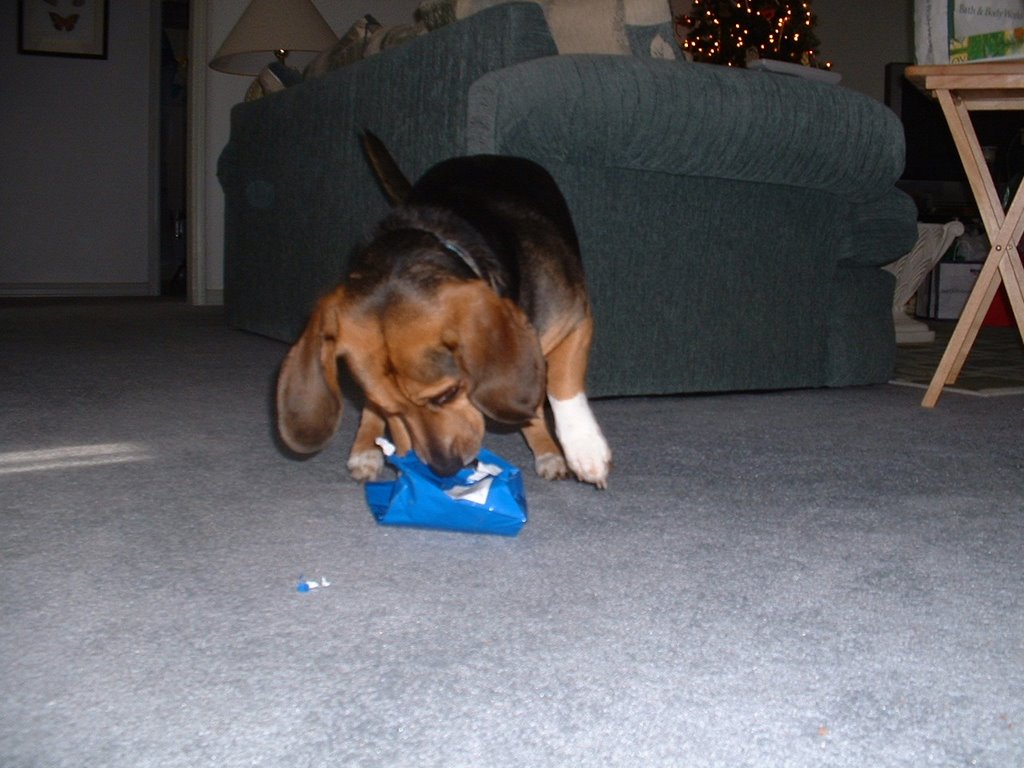
He's not a writer, but he lives with one. Shadow likes opening his gift each Christmas, and he always appreciates whatever he gets, especially if it's edible.
There are a number of writers on my gift list, and I thought I’d share some of the more successful gifts I’ve given friends and associates in the past.
Most writers will appreciate paper. Although we’re supposed to be moving towards a paperless society, I feed my printer more often than I feed my dog. I even use both sides of the paper for rough drafts and business records. Still, I buy more paper than I like to.
Office supplies are useful—notebooks, large paper clips, file folders.
Writers like pens. Good pens—black, red, or blue.
Many of us like coffee or tea. My daughter’s boyfriend gave me a Starbucks gift card for my birthday, and I really liked that gift. There’s also a great new book out by Travis Arndorfer and Kristine Hansen: The Complete Idiot’s Guide to Coffee & Tea. I bought a copy for myself and have enjoyed learning about the beverages I drink too much of.
Then there’s postage. Email has definitely reduced my postage bill, but I still use stamps. A sheet or two of stamps will be appreciated by anyone.
Subscriptions to magazines are a treat that will last the whole year. In my last post I noted my own favorites.
There are several books a writer may find useful. Here are a few:
The Renegade Writer by Linda Formichelli and Diana Burrell (great resource);Writing Down the Bones by Natalie Goldberg (for inspiration and crafting);The Brand Called You by Peter Montoya (for promoting your book).
For inspiration, consider giving your friend (writers and non-writers) a book of poetry. Any book of poetry. (We poets are famous for begging).
Some of us like wine. I picked up a copy of Wine: The 8,000 Year-Old Story of the Wine Trade by Thomas Pellechia. This is one of the liveliest, most interesting books on wine I’ve read. It’s a lovely, hardcover book with neat illustrations.
All the books mentioned here are available at a number of online sites.
Last but not least, invite your writing friend out for a cup of coffee or for lunch. We stay cooped up too much if we do this full-time.--Happy Shopping! Kay Day (11-27-06)
Because of the reading next week at the Library of Congress in Washington, D.C., my next post will be delayed.
Saturday, November 18, 2006
Subscriptions to mags: what to do
I was talking to my friend Dorothy Fletcher this morning about magazine subscriptions. I have too many. So this is the season, as the fiscal year ends, to take a look at my subs and decide who stays and who goes.
Dorothy's a writer, so we talked about a few publications she might subscribe to. I told her if I had only one subscription to a writing magazine, it'd be to The Writer. Before you proceed, I disclose I've written for the magazine, the handbook, and currently do a Net column "Poetry Beat."
But I can share the magazine has been on my desk since I was a 17-year-old in a small Southern town, dreaming of being a writer. There was a newsstand in my town. I'd leave my job as a dime store clerk each Friday afternoon and head for the newsstand. I'd always purchase a magazine. One week I'd buy The Writer. The next, I'd pick up The Atlantic. Then it'd be The New Yorker.
Many years later, the newsstand is gone. I subscribe to a number of magazines for different reasons.
The Writer is one I rely on for news, articles on crafting, information on publishing, contest announcements. I found a treasure trove of information by writers like W. Somerset Maugham and George Bernard Shaw. They were published in past issues of this magazine that's been a friend to writers since 1887.
I subscribe to Christian Science Monitor for their balanced news coverage, interesting features, and poetry. I write for them sometimes too.
I've never written for Time or the Weekly Standard. I buy the first for liberal news and the second for conservative news. Nor have I submitted to National Geographic, but it's a sub I can't do without.
I get the daily newspaper here because I start my day with it and like to read it with my coffee.
I get Health because I'd like to submit to them if an idea strikes and I like their articles on fitness and women's issues. I almost forgot to add Poetry. There's at least one poem that really sticks with me in each issue.
Those are the subs I'm sticking with. They've served me well.
--posted 11-18-06 by Kay B. Day
Note (11-21-06):Sigh. A dear one wrote to remind me I also write for the daily newspaper sometimes. See what happens when you try to disclose everything? Since I didn't mention it by name, I figured I'd done things up right. But my dear one is wise, so be aware: the Times Union has published my freelance articles in the local sections.
___________
I've signed up for something called Technorati Profile . So I have to put a link here. Dunno why, but I "claimed" my blog.
Dorothy's a writer, so we talked about a few publications she might subscribe to. I told her if I had only one subscription to a writing magazine, it'd be to The Writer. Before you proceed, I disclose I've written for the magazine, the handbook, and currently do a Net column "Poetry Beat."
But I can share the magazine has been on my desk since I was a 17-year-old in a small Southern town, dreaming of being a writer. There was a newsstand in my town. I'd leave my job as a dime store clerk each Friday afternoon and head for the newsstand. I'd always purchase a magazine. One week I'd buy The Writer. The next, I'd pick up The Atlantic. Then it'd be The New Yorker.
Many years later, the newsstand is gone. I subscribe to a number of magazines for different reasons.
The Writer is one I rely on for news, articles on crafting, information on publishing, contest announcements. I found a treasure trove of information by writers like W. Somerset Maugham and George Bernard Shaw. They were published in past issues of this magazine that's been a friend to writers since 1887.
I subscribe to Christian Science Monitor for their balanced news coverage, interesting features, and poetry. I write for them sometimes too.
I've never written for Time or the Weekly Standard. I buy the first for liberal news and the second for conservative news. Nor have I submitted to National Geographic, but it's a sub I can't do without.
I get the daily newspaper here because I start my day with it and like to read it with my coffee.
I get Health because I'd like to submit to them if an idea strikes and I like their articles on fitness and women's issues. I almost forgot to add Poetry. There's at least one poem that really sticks with me in each issue.
Those are the subs I'm sticking with. They've served me well.
--posted 11-18-06 by Kay B. Day
Note (11-21-06):Sigh. A dear one wrote to remind me I also write for the daily newspaper sometimes. See what happens when you try to disclose everything? Since I didn't mention it by name, I figured I'd done things up right. But my dear one is wise, so be aware: the Times Union has published my freelance articles in the local sections.
___________
I've signed up for something called Technorati Profile . So I have to put a link here. Dunno why, but I "claimed" my blog.
Tuesday, November 14, 2006
Poetry Beat at The Writer goes live
My first Poetry Beat column for The Writer is now live. Read about poet Lee Slonimsky and how his poems are woven into his wife’s popular mysteries. I discovered Slonimsky’s sonnets while reading Carol Goodman’s The Ghost Orchid.
I talked about the book here on my blog. One of the poet’s workshop students read the blog. Soon I was corresponding with Lee Slonimsky. Concurrently, we were developing plans for Poetry Beat at The Writer. It was so fortuitous, the timing, because I can’t think of a better poet to launch the column.
Do have a read, and see who’s up next. And send me your story tips or post them on the special forum for Poetry Beat.
Note: I learned the column is premium content, so it can only be read if you're a subscriber to the magazine.
I talked about the book here on my blog. One of the poet’s workshop students read the blog. Soon I was corresponding with Lee Slonimsky. Concurrently, we were developing plans for Poetry Beat at The Writer. It was so fortuitous, the timing, because I can’t think of a better poet to launch the column.
Do have a read, and see who’s up next. And send me your story tips or post them on the special forum for Poetry Beat.
Note: I learned the column is premium content, so it can only be read if you're a subscriber to the magazine.
Wednesday, November 08, 2006
Poems that go bump in the brain
Each month when my issue of Poetry comes, I keep it on my desk. When I take a break or have lunch, I like to thumb through the magazine and enjoy the poems. In the November, 2006, issue, there’s a poem that stopped me in my tracks. It’s one of those poems that lingers like the scent of a garden rose, powerful yet delicate and pleasing.
I’ve read it to my daughters, my husband, and visitors. Everyone who knows me is accustomed to my commanding them, “Listen to this!” I’ve shared poems by many writers with that command, including my own work.
This poet is Reginald Shepherd. The poem is “My Mother Was No White Dove.” This is a blow-your-mind poem, ripe with lines like, “My mother was the clouded-over night/a moon swims through…” This poem alone is worth the price of a subscription.
The bio note says all of Shepherd’s books are published by the University of Pittsburgh Press. His fifth, Fata Morgana, is due out this spring.
I don’t know the poet, but I’m grateful to him. His poem took me away for awhile, and those moments have a value that only a lover of poetry can understand.
And in the interest of disclosure, I can rave about the magazine because I've never been published there and I never will be.
So there you go.
____________________
Note: Thanks to all of you who've emailed me with news tips for my new column at The Writer. We have some sensational stories lined up. Column will debut mid-November. And continue to send me those tips!
I’ve read it to my daughters, my husband, and visitors. Everyone who knows me is accustomed to my commanding them, “Listen to this!” I’ve shared poems by many writers with that command, including my own work.
This poet is Reginald Shepherd. The poem is “My Mother Was No White Dove.” This is a blow-your-mind poem, ripe with lines like, “My mother was the clouded-over night/a moon swims through…” This poem alone is worth the price of a subscription.
The bio note says all of Shepherd’s books are published by the University of Pittsburgh Press. His fifth, Fata Morgana, is due out this spring.
I don’t know the poet, but I’m grateful to him. His poem took me away for awhile, and those moments have a value that only a lover of poetry can understand.
And in the interest of disclosure, I can rave about the magazine because I've never been published there and I never will be.
So there you go.
____________________
Note: Thanks to all of you who've emailed me with news tips for my new column at The Writer. We have some sensational stories lined up. Column will debut mid-November. And continue to send me those tips!
Thursday, November 02, 2006
New poetry column to debut at The Writer
My new bimonthly column Poetry Beat will launch in mid-November at the Internet site for The Writer magazine. The column will focus on the topical aspects of poetry. We’ll feature esteemed poets who’ve made their mark in the canon, as well as emerging poets who are taking poetry to the people in unusual ways. Opportunities, contests, and events will all be part of our coverage. A special discussion thread will be available on the forum so readers can send tips or post comments.
Poets House in New York showcased over 2,000 new poetry titles last year, according to information on the Net site. Those are just the collections in the showcase. Many others were published by independent presses and individuals.
We hope this column will grow into a forum for all poets, and a resource as well. Do visit often as we journey through Po-Biz together.—Best to all, Kay Day
Poets House in New York showcased over 2,000 new poetry titles last year, according to information on the Net site. Those are just the collections in the showcase. Many others were published by independent presses and individuals.
We hope this column will grow into a forum for all poets, and a resource as well. Do visit often as we journey through Po-Biz together.—Best to all, Kay Day
Friday, October 27, 2006
Grisham's new book focuses on conviction of innocent man
I just finished John Grisham’s The Innocent Man. I have a stack of books people have sent me, but I bought this one in hardcover.
As I read, the book made me think of a young man here in Florida. He was convicted of felony murder years ago. Although he played no direct role in the crime, he received a life sentence. I blogged about the case for over a year on a site that is no longer public.
Grisham tells the story of a man from Oklahoma, Ron Williamson. Williamson was a promising baseball player whose dream died because of drink, drugs and lack of discipline. He suffered from mental illness, and was railroaded by a prosecutor who had no real evidence but managed to create a case anyway.
The book gets a bit tedious in places, but overall it’s a good read. Grisham’s narrative reflects some of the same conclusions I came to as I blogged about the Florida case.
Our criminal justice system needs a complete overhaul. Those with money have a good chance of escaping punishment.
Those who don’t have money end up with public defenders and harsh sentences.
In my opinion, there’s a lot of law but very little justice.
As I read, the book made me think of a young man here in Florida. He was convicted of felony murder years ago. Although he played no direct role in the crime, he received a life sentence. I blogged about the case for over a year on a site that is no longer public.
Grisham tells the story of a man from Oklahoma, Ron Williamson. Williamson was a promising baseball player whose dream died because of drink, drugs and lack of discipline. He suffered from mental illness, and was railroaded by a prosecutor who had no real evidence but managed to create a case anyway.
The book gets a bit tedious in places, but overall it’s a good read. Grisham’s narrative reflects some of the same conclusions I came to as I blogged about the Florida case.
Our criminal justice system needs a complete overhaul. Those with money have a good chance of escaping punishment.
Those who don’t have money end up with public defenders and harsh sentences.
In my opinion, there’s a lot of law but very little justice.
Friday, October 20, 2006
Process
I was speaking at a writing/publishing seminar arranged by my publisher at Borders Books. The place was packed, and everyone there had an interest in some type of writing, with the majority of those present interested in fiction. My topic was “Research and Fact-Checking.”
Someone asked how we go about writing a book. Besides my publisher Frank Gromling, founder of Ocean Publishing, poet Michelle Leavitt (Powow River Anthology) and novelist Victor DiGenti (Windrusher series) were part of the speaking team that day. So each of us offered our own perspectives.
I shared the story of an interview with Nicholas Sparks. Years ago, I did an article about him for a now defunct Internet site. But I remember what he told me. He said when he starts a new book, he sketches it on a single page. He goes from there.
I have come to realize that I’m a spurt writer. Often I hop from document to document. I may have a poem open and an article for a magazine in addition to the file for my new nonfiction book.
I do prepare an outline for a book, but it’s a loose one and basically covers the points or topics I’ll write about. When the rough draft is ready, I print it and edit the hard copy. There’s an amazing reaction to seeing a 50,000 word document printed. For one thing, it just looks so big compared to a manuscript of 50-60 poems.
Ironically, poems are the hardest to write. They take longer. They have to cook longer, in my opinion.
Articles and essays are the most immediately rewarding. For one thing you get to see them in print quicker. I usually take an essay through five or six drafts.
I tend to think and compose within the writing process. I start out with one perspective and it may change, it will definitely deepen, and it will morph into something else entirely as the writing process progresses.
Victor DiGenti gave a great tip to fiction writers. He does a resume of each of his characters.
Many of the questions asked that day rested on self-publishing. I’ll write about that next time.
Each writer develops his or her own process. It's like voice: every writer has a different one.
What’s up: I’ll be reading with Dorothy K. Fletcher and Rize Cole at the Library of Congress for Poetry at Noon on December 5. A new essay will be out soon in Christian Science Monitor, and a story about a young writer who won a national award is forthcoming in the Florida Times Union. A sonnet is part of the new Letters to the World anthology (Red Hen) from the WOMPO poetry group online. The group was started by Annie Finch in 1997. And I’ll have an essay in the hardcover book Faces of Freedom edited by Rebecca Pepin.
Someone asked how we go about writing a book. Besides my publisher Frank Gromling, founder of Ocean Publishing, poet Michelle Leavitt (Powow River Anthology) and novelist Victor DiGenti (Windrusher series) were part of the speaking team that day. So each of us offered our own perspectives.
I shared the story of an interview with Nicholas Sparks. Years ago, I did an article about him for a now defunct Internet site. But I remember what he told me. He said when he starts a new book, he sketches it on a single page. He goes from there.
I have come to realize that I’m a spurt writer. Often I hop from document to document. I may have a poem open and an article for a magazine in addition to the file for my new nonfiction book.
I do prepare an outline for a book, but it’s a loose one and basically covers the points or topics I’ll write about. When the rough draft is ready, I print it and edit the hard copy. There’s an amazing reaction to seeing a 50,000 word document printed. For one thing, it just looks so big compared to a manuscript of 50-60 poems.
Ironically, poems are the hardest to write. They take longer. They have to cook longer, in my opinion.
Articles and essays are the most immediately rewarding. For one thing you get to see them in print quicker. I usually take an essay through five or six drafts.
I tend to think and compose within the writing process. I start out with one perspective and it may change, it will definitely deepen, and it will morph into something else entirely as the writing process progresses.
Victor DiGenti gave a great tip to fiction writers. He does a resume of each of his characters.
Many of the questions asked that day rested on self-publishing. I’ll write about that next time.
Each writer develops his or her own process. It's like voice: every writer has a different one.
What’s up: I’ll be reading with Dorothy K. Fletcher and Rize Cole at the Library of Congress for Poetry at Noon on December 5. A new essay will be out soon in Christian Science Monitor, and a story about a young writer who won a national award is forthcoming in the Florida Times Union. A sonnet is part of the new Letters to the World anthology (Red Hen) from the WOMPO poetry group online. The group was started by Annie Finch in 1997. And I’ll have an essay in the hardcover book Faces of Freedom edited by Rebecca Pepin.
Monday, October 09, 2006
Another Goodman novel coming soon
A couple days ago, I was talking to a friend about novels. I mentioned how much I enjoyed reading Carol Goodman’s books. So when news of her new novel The Sonnet Lover came, I pre-ordered the book.
Goodman usually works mythology and poetry into her books. I’ve read each of her novels, and her voice and style have steadily grown stronger and more distinctive.
There’s an interesting interview at Beatrice. I'd like to interview her--I think she'd be very interesting.
This author is a born storyteller, but she’s literary without being oppressively literary. The books entertain, and they also make the reader think. She’s very good at weaving several subplots into the main plot. Her last book included fine sonnets by her husband Lee Slonimsky. I’m awaiting her new book to see the tie-in with the title.
Otherwise, autumn is always busy for a freelancer. Exciting speaking events coming up include my reading with two other Florida poets at the Library of Congress. I’ve never been to Washington, so doing poetry there and being able to see the capital will be a treat. I’m hacking my way through my nonfiction book, trying to decide where to go once it’s finished. And as always, tinkering with my poetry manuscript in the last stages of the final edit. Well, the almost final edit. I feel like my poems are never really finished.
Goodman usually works mythology and poetry into her books. I’ve read each of her novels, and her voice and style have steadily grown stronger and more distinctive.
There’s an interesting interview at Beatrice. I'd like to interview her--I think she'd be very interesting.
This author is a born storyteller, but she’s literary without being oppressively literary. The books entertain, and they also make the reader think. She’s very good at weaving several subplots into the main plot. Her last book included fine sonnets by her husband Lee Slonimsky. I’m awaiting her new book to see the tie-in with the title.
Otherwise, autumn is always busy for a freelancer. Exciting speaking events coming up include my reading with two other Florida poets at the Library of Congress. I’ve never been to Washington, so doing poetry there and being able to see the capital will be a treat. I’m hacking my way through my nonfiction book, trying to decide where to go once it’s finished. And as always, tinkering with my poetry manuscript in the last stages of the final edit. Well, the almost final edit. I feel like my poems are never really finished.
Monday, October 02, 2006
Resources for news in a Florida classroom
Every day my high school senior comes home and regales me with stories. It’s one of the highlights of my day, sitting down around 4 p.m. with her. As she packs in the food, I listen, appreciating not only her storytelling skills but her perspectives as well. I also appreciate the blessing of thin people who can eat multiple servings of carbs and never gain a pound.
Today, it came as a complete surprise to me when my daughter told me she isn’t allowed to use the Internet or newspapers either as a resource for her honors history class (American Government). The only acceptable source is television news.
You can imagine my surprise. For one thing, there is no better resource for information about politics and world affairs than the Net, provided you go to reputable sites. For another, television news is often skewed politically one way or the other. For yet another, there isn’t an anchor who bears the charisma of the old guard, all of whom are gone now. The possible exception to this is a fellow named Shepard Smith. He does a show on Fox News. It’s straight news, with no commentary or as best I can tell, no advocacy platform. I don’t watch it very often, because I don’t watch much TV anyway.
I am around a lot of teens and college students, courtesy of my daughters. I have come to one conclusion and I don’t need a survey to back me up.
Young people get their news from the Net mostly. If they’re watching TV, they aren’t watching news. Young people will also read the Entertainment section in the newspaper. Young people in Jax will read the Sports section because this is where the Jags live.
As for omitting newspapers as a news source, that is an intellectual ripoff because print media often provides more in-depth coverage than the Net or TV. What about magazines? What about books? With elections pending, books will multiply like Florida lovebugs in September, and believe me, those little bugs are everywhere right now. When I sit outside with a cup of coffee, I check it to make sure there aren’t a couple of those flighty critters swimming around in it.
It’s a teacher’s call on how to run a class. It’s my call to comment on that and anything else of interest. Freedom to opine is a small perk (all the perks are small) of being a freelance writer in a free country.
Come to think of it, that freedom began with newspapers long ago.
A few of my many favorite links:
The Drudge Report
www.drudgereport.com
Time Magazine
www.time.com/time/
Google News
www.news.google.com/nwshp?ie=UTF-8&hl=en&tab=wn&q=
NewsLink (includes links to newspaper, TV, radio)
www.newslink.org/
Christian Science Monitor
www.csmonitor.com
Today, it came as a complete surprise to me when my daughter told me she isn’t allowed to use the Internet or newspapers either as a resource for her honors history class (American Government). The only acceptable source is television news.
You can imagine my surprise. For one thing, there is no better resource for information about politics and world affairs than the Net, provided you go to reputable sites. For another, television news is often skewed politically one way or the other. For yet another, there isn’t an anchor who bears the charisma of the old guard, all of whom are gone now. The possible exception to this is a fellow named Shepard Smith. He does a show on Fox News. It’s straight news, with no commentary or as best I can tell, no advocacy platform. I don’t watch it very often, because I don’t watch much TV anyway.
I am around a lot of teens and college students, courtesy of my daughters. I have come to one conclusion and I don’t need a survey to back me up.
Young people get their news from the Net mostly. If they’re watching TV, they aren’t watching news. Young people will also read the Entertainment section in the newspaper. Young people in Jax will read the Sports section because this is where the Jags live.
As for omitting newspapers as a news source, that is an intellectual ripoff because print media often provides more in-depth coverage than the Net or TV. What about magazines? What about books? With elections pending, books will multiply like Florida lovebugs in September, and believe me, those little bugs are everywhere right now. When I sit outside with a cup of coffee, I check it to make sure there aren’t a couple of those flighty critters swimming around in it.
It’s a teacher’s call on how to run a class. It’s my call to comment on that and anything else of interest. Freedom to opine is a small perk (all the perks are small) of being a freelance writer in a free country.
Come to think of it, that freedom began with newspapers long ago.
A few of my many favorite links:
The Drudge Report
www.drudgereport.com
Time Magazine
www.time.com/time/
Google News
www.news.google.com/nwshp?ie=UTF-8&hl=en&tab=wn&q=
NewsLink (includes links to newspaper, TV, radio)
www.newslink.org/
Christian Science Monitor
www.csmonitor.com
Tuesday, September 26, 2006
Can't speak Farsi? Me neither.
I write a column for a site with a focus on homeland security. When I’m checking facts, or trying to learn more about global political events, I have to rely on whoever translated if the site is from a country whose language I can’t speak.
I recently discovered the site MEMRI: The Middle East Media Research Institute. I found translations from media in many different countries. The site is well-organized and also has a film section. According to the description, material is translated into seven different languages.
Considering the complexities in world politics today, sites like this one really help. Anyone interested in the Middle East will find very interesting reading. Some paint MEMRI as biased against the Arab world, but since I read Arab news sites as well, I can at least compare information and make an informed decision. Problem is I have to read the Arab sites in English.
I’ve focused on studying the Middle East lately because of the column. And I just ordered an interesting looking new book Letters from an American Farmer by J. Hector St. John De Crevecoeur. The book was first published in England in 1782 as the Revolutionary War of Independence came to an end. I’m looking forward to reading about American concerns at that time. The book, according to the back cover blurb, was “written by an emigrant French aristocrat turned farmer."
I realized most of the books I’ve read lately are either poetry or nonfiction, with the exception of Marcia Preston’s excellent The Butterfly House. I highly recommend her novel; it was a very good read. She uses the motif of the study of butterflies, and successfully creates a character we care about. The book embodies a mystery, and features some very interesting characters.
Gazing around my office, I realize there are so many books I want to read. And write. As always, those are good problems for a writer to have.
I recently discovered the site MEMRI: The Middle East Media Research Institute. I found translations from media in many different countries. The site is well-organized and also has a film section. According to the description, material is translated into seven different languages.
Considering the complexities in world politics today, sites like this one really help. Anyone interested in the Middle East will find very interesting reading. Some paint MEMRI as biased against the Arab world, but since I read Arab news sites as well, I can at least compare information and make an informed decision. Problem is I have to read the Arab sites in English.
I’ve focused on studying the Middle East lately because of the column. And I just ordered an interesting looking new book Letters from an American Farmer by J. Hector St. John De Crevecoeur. The book was first published in England in 1782 as the Revolutionary War of Independence came to an end. I’m looking forward to reading about American concerns at that time. The book, according to the back cover blurb, was “written by an emigrant French aristocrat turned farmer."
I realized most of the books I’ve read lately are either poetry or nonfiction, with the exception of Marcia Preston’s excellent The Butterfly House. I highly recommend her novel; it was a very good read. She uses the motif of the study of butterflies, and successfully creates a character we care about. The book embodies a mystery, and features some very interesting characters.
Gazing around my office, I realize there are so many books I want to read. And write. As always, those are good problems for a writer to have.
Monday, September 18, 2006
Kids get a laureate
“CHICAGO — The Poetry Foundation will inaugurate the nation’s first Children’s Poet Laureate: Consultant in Children’s Poetry to the Poetry Foundation, as part of the third annual Pegasus Awards ceremony in Chicago on September 27, 2006.”—news from The Poetry Foundation September 18, 2006
John Barr, president of The Poetry Foundation, says children’s poets go unrecognized. I’d have to agree with him. But then poetry in general often goes unrecognized. Designating a poet whose work resonates with youth certainly can’t hurt.
Children respond to poetry with levels of honesty and acceptance unreachable by adults. If youth experience poetry early on, there’s a chance as adults they will be receptive to it.
I believe reading poetry and responding to it will enhance anyone’s education. My own children are strong writers and readers. As toddlers, they’d always calm down when I read to them. My daughters were wide open at an early age, so I used books and together-time to help them learn to sit still and pay attention. We also used stories and poems as springboards for the imagination. As they’ve grown older, they’ve both made a place for poetry in their lives.
It perplexes me that unlike many other countries, America keeps poetry confined to aesthetic tribes and small journals. I’ve never understood why major women’s magazines don’t publish poetry. More newspapers seem to be giving the genre some attention, and on occasion, a television program will feature someone reading a poem either at a funeral or a wedding.
I encourage others to read poetry because, in my opinion, it adds a beautiful dimension to life. I’ve often thought poetry could use a few more good missionaries. Billy Collins, Ted Kooser, and Annie Finch are fine poets who, by various activities like readings and networks, have furthered the reach of our purest form of writing.
On the other hand, I’ve suffered through more than one reading where I wish the poet had kept things to himself.
Poets. We’ll never be 100% happy with anything. If we were, we’d be writing fiction.
Subscribe to:
Posts (Atom)